6i Lens · Portfolio of a Scholar

Eleven pages.
One missing piece.

New York does not test mathematics before Grade 3, so the first three pages are illustrative, built from 6i's internal K–2 Error Taxonomy rather than a released item. From Grade 3 through Grade 8, every question shown is a real New York State 2024 released item, reproduced from the state's public release. Algebra I and Geometry are illustrative too, standing in for the literal Regents items, because what they capture, building the relationship instead of only running it, is what every page beneath them was building toward. Watch one missing piece, holding a quantity as a single countable unit, break at a harder standard on every page.

Page 1 of 11 · Kindergarten

K

NY-K.OA.1, 2a–2b · Joining and separating sets
Illustrative · 6i K–2 Error TaxonomyNo state test exists at this age
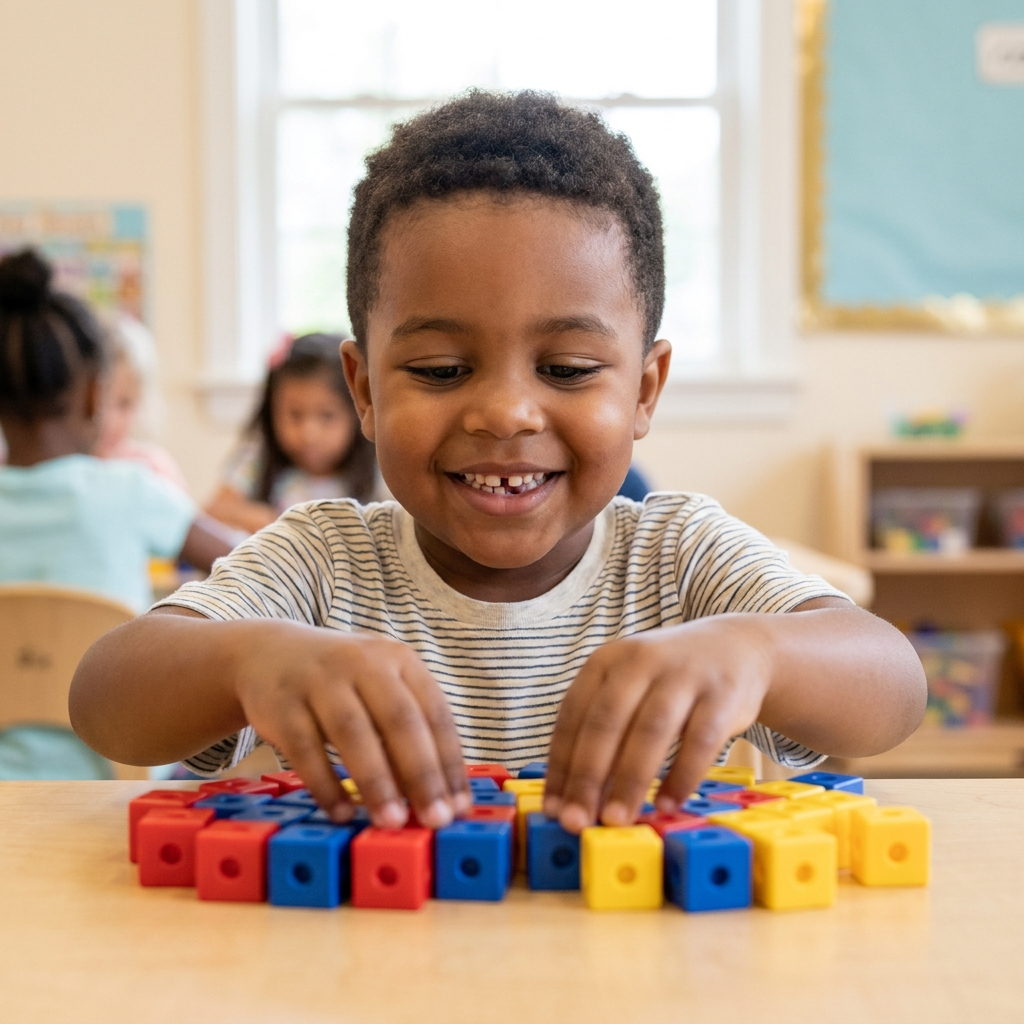
Salih in Kindergarten, sitting at a classroom table and pushing counting blocks together with both hands.
Kindergarten

At five, he joins happily. Hand him three blocks and two more and he pushes them all together, then counts the whole pile again from one, fingers moving fast. He is not wrong. He has simply not yet built the habit of holding the first amount steady while he adds to it, and at five, nobody expects him to.

Task: three frogs on a log, two more hop in. How many frogs now?
The wrong turnHe recounts all five from one, "one, two, three, four, five," instead of holding the three and counting on from it.
The bridgeHold the three. Do not recount it. Count on: four, five. Holding a quantity while you act on it is the seed every later operation is built from.
1

NY-1.OA.8 · Unknown in any position

Illustrative · 6i K–2 Error TaxonomyNo state test exists at this age
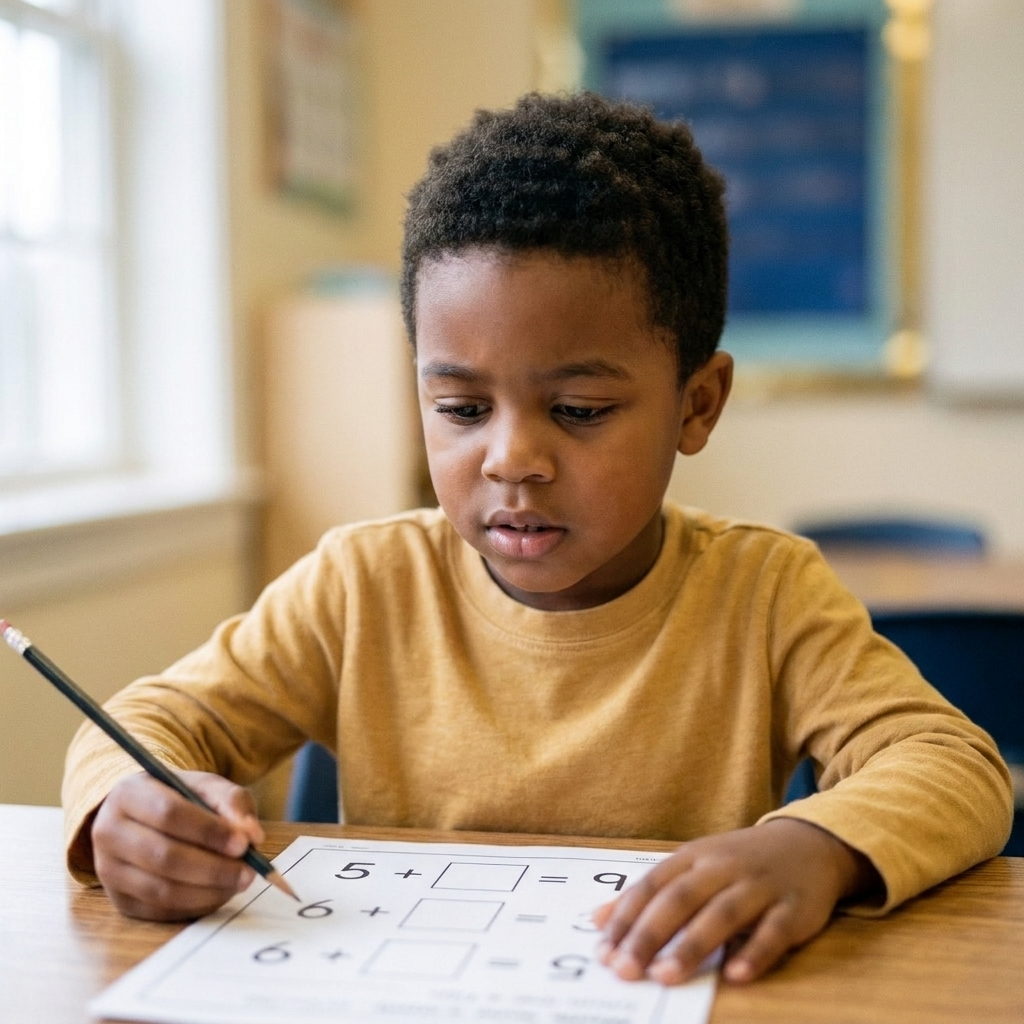
Salih in first grade at his desk, pencil in hand, looking steadily at a worksheet with an addition sentence on it.
Grade 1

By first grade he solves 5 + 2 = ? without blinking. Turn the equation around, put the box first, and something closes. The equals sign has only ever meant "compute now." It has never meant the two sides have to balance.

Task: a bar model for □ + 3 = 7. What's hiding in the box?
The wrong turnHe adds the two numbers he can see, 3 + 7 = 10, instead of finding the part that makes both sides equal. The box holds 4, not 10.
The bridgeA bar model: the whole is 7, one part is 3, the missing part has to be 4. The box is a part, not an instruction. This is where algebra actually starts.
2

NY-2.OA.3–4 · Arrays and equal groups

Illustrative · 6i K–2 Error TaxonomyNo state test exists at this age
Salih in second grade, leaning over a dot array on his page and touching each dot in turn as he counts.
Grade 2

Second grade puts arrays everywhere: rows of desks, egg cartons, a calendar grid. Shown three rows of four dots, he counts every single dot, careful not to skip one. A row has not yet become a single thing he can hold. It is twelve separate invitations to count.

Task: a 3-by-4 dot array. How many in each row? How many rows? How many in all?
The wrong turnHe reaches twelve correctly, but only by touching every dot. Asked for an equation, he writes 4 + 4 + 4 without noticing the rows are equal, or accepts an unequal 4 + 3 + 5 just as readily.
The bridgeOne row is the unit: four. Three rows, each the same: 4 + 4 + 4 = 12, which is also three groups of four. Seeing a row as one repeated unit is next year's whole idea, one year early.
3

NY-3.OA.3 · Equal groups

Tier 1·rank 1·P̄ 0.61·NYS 2024
Salih in third grade, concentrating on a row of linking cubes he has lined up along his desk.
Grade 3

Third grade hands him a real released item. He fills the margin with careful dots, tongue between his teeth, and lands on the right total. He never circles a group. To him, multiplication is still just faster counting he hasn't learned to rush.

Real 2024 NYS released item, Grade 3
The wrong turnHe picks B, 9 + 8. He sees two numbers and adds them. The correct choice is D, 9 × 8 = 72, nine groups of eight, and the group never registered as a group.
The bridgeOne box is the unit: 8 books. Nine boxes, all the same: 9 × 8 = 72. The structure is groups, so the operation is multiplication, not the addition he reached for.
4

NY-4.OA.2 · "Times as many"

Tier 1·P̄ 0.66·NYS 2024
Salih in fourth grade at a classroom desk, pencil poised over a word problem, reading the question closely.
Grade 4

By fourth grade he has learned to hunt for keywords instead of picturing the math. "How many more" means subtract, "in all" means add, and it works often enough that his grades look fine. Then "times as many" arrives, and he reaches for the nearest number and adds.

Real 2024 NYS released item, Grade 4
The wrong turnHe picks B, 12: he adds 9 + 3. "Three times as many" gets read as "three more." The correct choice is D, 27 = 9 × 3. This is the exact additive habit that fails him again in Grade 7.
The bridgeCarter's 9 is one unit. "Three times as many" means three copies of that unit, laid end to end: 3 × 9 = 27. You copy the unit. You never add to it.
5

NY-5.NF.6 · A fraction of a quantity

Tier 1·rank 2·P̄ 0.32 (hardest)·NYS 2024, constructed response
Salih in fifth grade, quiet and focused, working through a fractions problem with his hand resting on the page.
Grade 5

Fifth grade is where he starts to go quiet. Whole numbers he can still bluff. Fractions ask him to hold a part and a whole at once, and he has never had a unit steady enough to build one on.

Real 2024 NYS released item, Grade 5 (constructed response)
The wrong turnHe answers "Steve," reaching for the bigger-sounding number. He can't see that scaling by a fraction under 1 makes a quantity smaller, so the correct answer is Rosa.
The bridgeCut Rosa's collection into 8 equal parts. Steve is one of those parts. One part is never bigger than all eight, so Rosa has more. Scaling by a fraction is still multiplying. It just shrinks.
6

NY-6.RP.2 · Unit rate

Tier 1·rank 5·P̄ 0.57·NYS 2024
Salih in sixth grade, sitting up at his desk with his notebook open, thinking through a written-response question.
Grade 6

Sixth grade asks him for a rate, and the recognition tricks that carried him for three years start missing. The choices are still on the page. What is gone is the keyword: there is nothing in this item to hunt for, so his old trick never even fires.

Real 2024 NYS released item, Grade 6
The wrong turnHe picks D, 96: he subtracts 104 minus 8. The correct choice is A, 13, from 104 ÷ 8. With no unit to anchor to, he operates on whatever two numbers he can see.
The bridgeA ratio table: 8 ounces over 104 calories, divide both to the 1 row. One ounce is 13 calories. Every rate passes through one. Subtracting never enters it.
7

NY-7.RP.3 · Proportional scaling

Tier 1·rank 1·P̄ 0.48·NYS 2024
Salih in seventh grade, working steadily through a proportion problem, his notebook covered in worked steps.
Grade 7

Seventh grade moves in ratios and proportions all day, and he is still adding across, because it is the only structure he ever built. He lands on answers close enough to feel right and wrong enough to be marked wrong, over and over, and can't tell why.

Real 2024 NYS released item, Grade 7
The wrong turnHe picks D, 6⅛: he adds the two quantities, 2⅝ + 3½, instead of dividing to find one batch. The correct choice is A, ¾ cup.
The bridgeA ratio table again: divide both numbers down to 1 batch. ¾ cup per batch. Dividing finds the per-one. Adding never could.
8

NY-8.EE.5 · Unit rate as slope

Tier 1·rank 1·P̄ 0.48·NYS 2024, constructed response, 2 points
Salih in eighth grade, studying a coordinate graph on the page in front of him with his pencil held still.
Grade 8

By eighth grade he has a system, and the system is disappearing. He copies enough not to get called on and keeps his head down through anything with a graph. Ask him which line is steeper and he counts boxes. Ask him why, and he goes still.

Real 2024 NYS released item, Grade 8 (constructed response, 2 pts)
The wrong turnHe compares the biggest numbers he can find, 224 against 200, instead of reducing each dog to feet per second. He never sees that speed is a unit rate, and a unit rate is a slope.
The bridgeDog A: 56 feet in 2 seconds is 28 feet per second. Dog B: 200 feet in 8 seconds is 25 feet per second. The difference is 3 feet per second, and each "per one second" is the slope.
Alg I

AI-A.CED.1 · Construct y = kx

Tier 1·P̄ 0.58·Regents, June 2024Illustrative item, literal Regents item to follow
Salih in Algebra I, pen in hand over a page of equations, holding on a word problem before he writes.
Algebra I

In Algebra I he can push symbols around cleanly. Hand him y = kx and a value and he solves it without trouble, which fools everyone, himself included, into believing the gap closed years ago. Then a word problem asks him to build the equation from a situation, and there is nothing to reach for.

Task: a car travels at a constant speed and goes 150 miles in 3 hours. Write an equation for the distance y in terms of the time x.
The wrong turnHe leaves it blank. He can run the machine. He cannot build it, because he cannot find k, and k is the unit rate he never learned to isolate.
The bridgeThe same ratio table: 150 miles over 3 hours, divide to the 1 row. 1 hour is 50 miles. That unit rate is k. Write it once: y = 50x. Slope is the unit, the same one, born in Grade 3.
Geo

GEO-G.SRT.1b · Dilation and scale factor

Tier 1·High school GeometryIllustrative item · standard text is NYSED's
Salih in high school Geometry, drafting a figure with a straightedge, working with care and precision.
Geometry

One course later, in Geometry, he is precise. He measures the segment, checks it against the given scale factor, and writes his answer without hesitating. The answer is eight, and the reasoning under it is seven years old. A scale factor of three still reads to him as three more rather than three copies. Nobody caught it in Algebra I either, because there he simply left the page blank and a blank looks like not studying. Here he is confident and wrong, which is harder to see and worse to leave. New York names this coherence in its own course materials: Geometry students are expected to formalize the similarity ideas of "same shape" and "scale factor" developed in the middle grades, and the state prints the arrow itself, NY-8.G.3 pointing forward into GEO-G.SRT.1.

Task: a dilation with center P and scale factor 3 maps segment AB to segment A′B′. If AB = 5, what is A′B′?
The wrong turnHe writes 8. He reads the multiplier as an amount to add, 5 + 3, so the segment grows by three instead of scaling by three. The correct length is 15.
The bridgeThree copies of the length, laid end to end: 5 × 3 = 15. A scale factor multiplies a length. It does not extend it. This is the Grade 4 comic-book question again, in a drafting notebook.

Use the arrows, the left and right keys, or swipe on a phone. Every page stays in the document whether the turn animates or not.

The cost of recounting

Counting on is the first time a number stands for an amount instead of a place in a sequence. Say three and you are done saying it. Four and five are all that is left to add. A child who starts back at one every time is treating the pile as loose objects, and loose objects cannot be held steady. Nothing on the ten pages ahead asks him to count. Every one of them asks him to hold.

Eleven pages, one construction. Read it forward and it is a diagnosis: the unit never forms at Grade 3, "times as many" gets read as addition at Grade 4, a fraction cannot scale at Grade 5, there is no "per one" at Grades 6 and 7, a rate is never a slope at Grade 8, k can never be isolated in Algebra I, and a scale factor gets added instead of multiplied in Geometry a course later. Read it backward and it is the fix: rebuild the unit once, at the root, and the whole column above it holds.

Work with 6i Lens

See what this looks like in your building.

This scholar's arc and this school's record are one method, run at two different scales. We can start wherever your data already points, one standard or a whole grade band.

or write to admin@6i-lens.com